THE WORLD HUMAN PEACE FOUNDATION
From the founder
Francisco Armani on authoritarianism, mortality, technology and what we leave behind.
04 / FROM THE FOUNDER
A wall can fall. Its mentality can survive.
A personal statement by Francisco Armani on authoritarianism, mortality, technology and the world we leave behind.
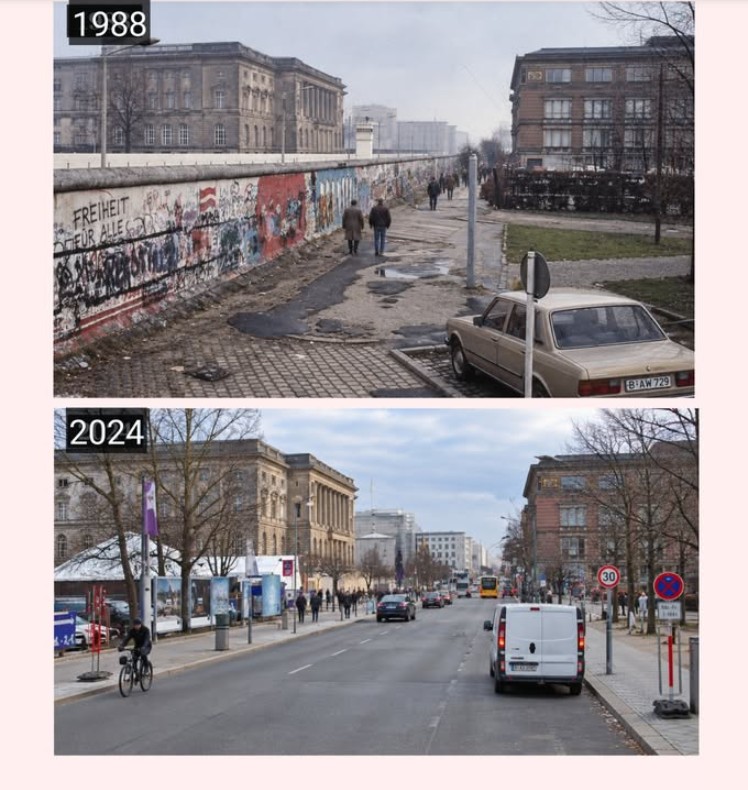
BERLIN’S WALL — THEN AND NOW
Look carefully at these two photographs. 1988 and 2024. It was not that long ago.
In 1988, the Berlin Wall still divided human beings from one another. Vladimir Putin was then a KGB officer stationed in Dresden. A year later the Wall fell, and millions believed that Europe had finally left this darkness behind.
But history should have taught us something much harder: walls can disappear without the mentality that built them disappearing.
Authoritarianism does not always return wearing the same uniform. It learns. It modernizes. It acquires lawyers, corporations, propaganda networks, technology and sophisticated methods of surveillance and control. What once required a concrete wall and armed guards can eventually be accomplished through fear, information, money and power.
And humanity repeatedly makes the same mistake. When one dictator or brutal regime disappears, history eventually begins sanitizing what happened. Assad, Gaddafi, Saddam Hussein and others become subjects of nostalgic arguments about whether things were somehow “better” under them. We forget what unchecked power actually did to ordinary human beings.
My wife and I created our nonprofit to give peace a stronger public voice. We financed the development of the concept and began a journey of remembrance, testimony and advocacy. Our next step is to build the Peace Against All Wars worldwide campaign through professional communications and committed supporters.
And that forced me to confront a question I have carried since childhood.
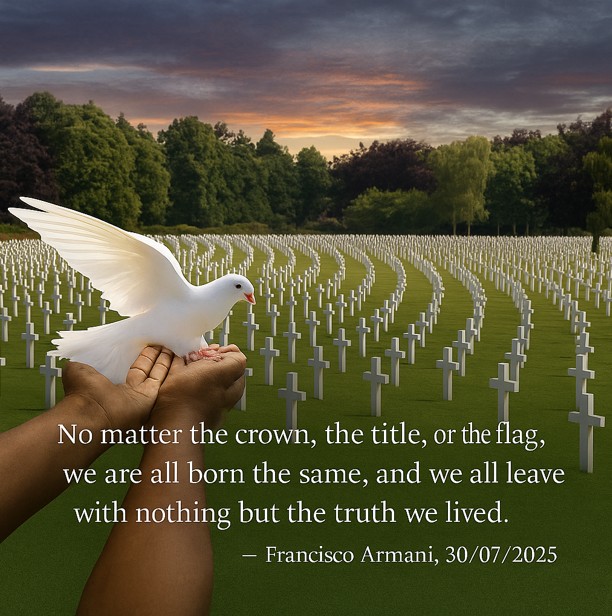
Humanity has created gods, religions, kings, princes, popes, presidents and countless titles for people supposedly standing above ordinary men and women. Throughout history, some institutions created around those ideas have done enormous good; others have been used to justify conquest, obedience, wealth and killing. No title makes one human life intrinsically more valuable than another.
A king dies. A president dies. A billionaire dies. A pope dies. A homeless person dies.
Whatever monuments we build around ourselves, our bodies ultimately meet the same biological end. Gold around a coffin does not prevent what happens inside it. Power cannot negotiate with mortality.
Perhaps that is the great absurdity of our species: people can spend an entire lifetime accumulating wealth, territory and authority that they already know they cannot keep.
I knew from a very young age that I did not believe in the traditional picture of God, heaven and hell. Looking at what human beings did to one another, sometimes it seemed that if hell existed, we had already constructed parts of it here ourselves.
Yet there remains something profound that none of us fully understands: consciousness itself. Why are we here? Why can matter become conscious enough to contemplate its own existence? Is there something beyond what our brains are capable of perceiving? I don’t pretend to know. Perhaps human beings simply aren’t equipped to understand everything about their own existence.
What I do know is this: you cannot miss a reality you have never experienced. We are born into a particular version of human existence and naturally assume that this is simply what existence is.
And now humanity is building something unprecedented: artificial intelligence capable of collecting, connecting and interpreting extraordinary amounts of human information. We should be extremely careful about assuming that anything entrusted to digital systems is guaranteed to disappear forever. Governments, corporations and societies need enforceable limits on retention, surveillance and the use of personal information. Technology capable of liberating people can also become technology capable of controlling them.
The photograph from 1988 should therefore not make us congratulate ourselves.
It should warn us.
Human beings tore down that wall. Human beings can build another one.
Maybe the next wall won’t be made from concrete.
And perhaps real progress will begin only when humanity understands that power, money and titles are temporary, while what we do to other human beings during the short time we are alive is what actually defines the world we leave behind.
Peace — and I hope we understand this before each of us eventually closes our eyes for the last time.
Francisco Armani
The World Human Peace Foundation